Ad Section

Hiển thị các bài đăng có nhãn ethereum. Hiển thị tất cả bài đăng

Thứ Hai, 8 tháng 10, 2018

Review ICOVO ICO - the world’s first and only ICO platform

Review ICOVO ICO - the world’s first and only ICO platform

MISSION &VISION

ICOs are at the crux of the ecosystem necessary for hatching innovative blockchain-related startups.


ICOVO will support a healthy ICO which will make a future by offering ICOVO Web、ICOVO App and DAICOVO. Details are described below in three points.
  • Increase ICO Transparency and Protect Investors
  • Reduce Barriers for ICO Participation
  • Increase Project Durability
Increase ICO Transparency and Protect Investors

We aim to protect ICO investors by introducing a fundraising management system and
increasing the transparency of ICO project founders as well as the projects themselves.


+ Decentralized Token Management: We will create DAICOVO, an original smart contract incorporating DAICO’s fundamental idea of decentralized token management.
We will introduce a system that only allows withdrawals according to the capital demand of a project’s pre-loaded schedule through a Tap system (setting an amount that can be withdrawn per unit of time). This will prevent developers from running off with raised funds.
In the event that an investor notices a problem with the project, they are able to retract their investment that was raised under agreement as a refund.

+ Decentralized White Paper Versioning: Versioning for White Paper not to be tamperd is managed by InterPlanetary File System (IPFS).
+ Team Member KYC/AML:
We will increase ICO project team member’s transparency by providing ICO project team member’s KYC/AML on ICOVO website in a centralized method.
+ Visualize Activity Situation: We will increase project transparency by quantifying social media activity and GitHub updates on ICOVO’s website.

Reduce Barriers for ICO Participation
Create a better investment environment and reduce barriers to ICO participation by unifying the investment process and the format for information disclosure.


+ Implementing Local Wallet: Implementing a safe local wallet in ICOVO's original ICO-specialized smartphone app, the ICOVO App, helps with understanding the participation process for complicated token sales and managing tokens.
+ Unifying Formats
ICO project pages and summaries of whitepapers on ICOVO’s website presents information consicely, making it easier to understand for investors. Accessibility is enhanced by offering a summary of all the projects using the same format.
+ Reducing labor for KYC
Eliminate the need for ICO investors to do KYC each time they invest. When they participate in ICO project token sales on the ICOVO App, they perform KYC only once as ICOVO will share the information with the ICO project founders.

Increase Project Durability
Sustain project founders' motivation for product release and increase project durability by introducing a system in which project founders can only withdraw tokens according to their investment demand milestone.


+ Fund acquisition≠Goal: By introducing a system of original smart contracts implementing DAICOVO in which funds can only be withdrawn according to a project’s pre-loaded schedule by Tap (set an amount that can be withdrawn per unit of time), motivation to finish the project founders.

DAICOVO: Smart contracts implementing the DAICO model

In addition to the functions required by ICO project founders such as issuing, selling, and managing unique tokens, DAICOVO offers smart contracts optimized for ICOs adopting the DAICO model. For ICO project founders who use DAICOVO to do their ICO on ICOVO Web, all of the required work, including token design, DAICOVO parameter setting, compilation, and deployment, is free. We plan to release DAICOVO as open source.
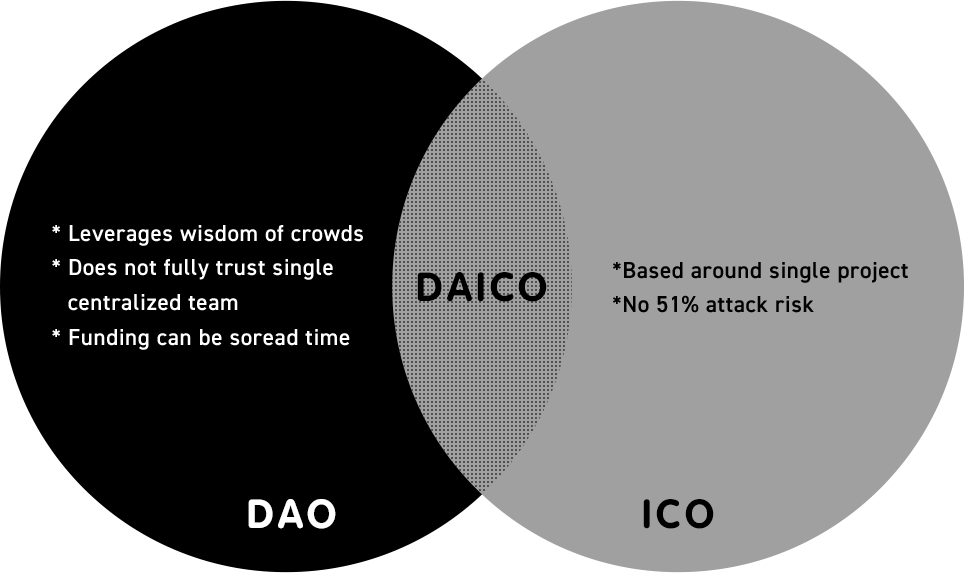


Proposed by Ethereum co-founder Vitalik Buterin on January 6, 2018, a DAICO is a model that uses decentralized methods to prevent planners from dishonestly using funds raised through an ICO. In ICOs using tokens that conform to the ERC20 standard, smart contracts are used to limit the amount of funds raised that project founders can withdraw per unit of time, and if the project is canceled for whatever reason, the remaining funds can be returned to the ICO investors if a consensus is reached

ICOVO App: A smartphone app featuring a wallet optimized for ICOs


ICOVO's iOS/Android features a multi-token multi-account wallet compatible with ETH and ERC20 tokens based on the safe private wallet, Wallet format with the purpose of enhancing security by storing the private key only in the mobile device not online, that has been released and is already in use by many, Tachyon, developed from scratch by our CTO Nishimura.

ICOVO App have the one stop solution for investors and project founders. Project founder don't need to develop it anymore.

ICOVO App also have dashboard features,KYC/AML,Whitelist registration, Whitepaper viewer,ICO project list integrates with ICOVO Web and Photo ID uploader.

Furthermore it include DAICOVO user interface and has the interface for Decentralized Exchange(DEX) where users can trade their tokens.

ICOVO Web: An ICO listing site with thorough ICO investor protections
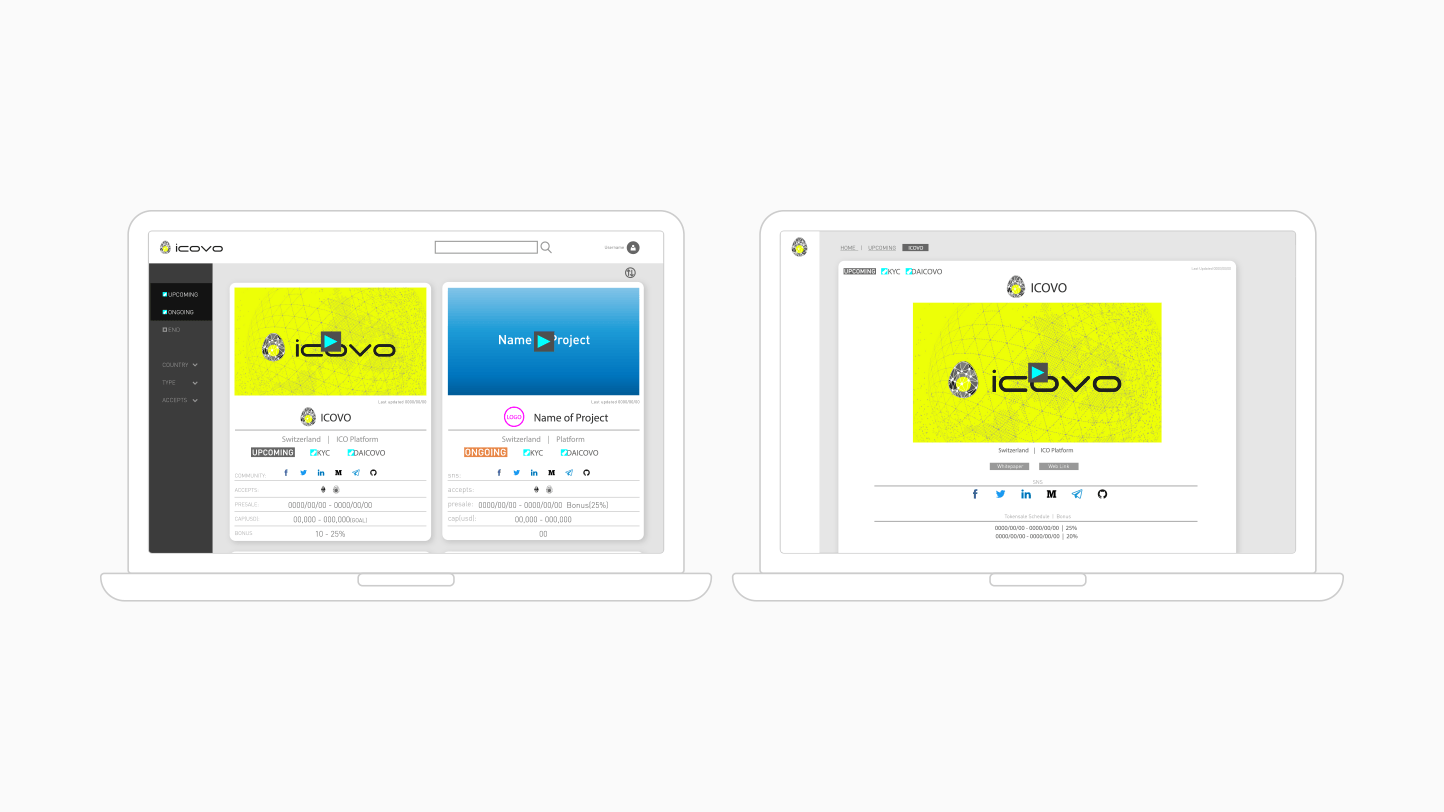

ICOVO Web is a website for ICO project founders to list their ICOs for investors. It thoroughly protects ICO investors and lists only ICO projects that comply with ICOVO requirements. The criteria for listing on ICOVO are the utilization of DAICOVO, planner KYC/AML as required by ICOVO, and disclosure of the progress of the project.

The biggest feature is whitepaper versioning using IPFS. All the whitepapers of ICO projects listed on ICOVO Web are managed by IPFS and Block chain. Whitepaper versioning through IPFS storage and block chain makes it impossible to tamper with whitepapers later on. This means that even if investors fail to download the whitepaper before the ICO or lose it, they can always verify whether the project is proceeding according to the original whitepaper, and if it is not, they can draft and vote to have their money refunded.

The KYC required by ICOVO, which includes passport-based ID verification and AML, applies not only to the investors but also to the ICO project founders. Furthermore, in order to increase the transparency of ICO project activity, ICOVO shares the state of progress on the project by quantifying and displaying the project's use of GitHub, social media, and other major tools.

ICOVO also requires a uniform format for certain essential whitepaper items so that each ICO project planner's whitepaper can be read in a unified format. The ICOVO App is synchronized with the ICO list information and bookmark function so that ICO investors can achieve participation all in one place.

We also provide ICO project founders with a white-label dashboard for investors including a referral program, airdrop program, KYC/AML and more.

TEAM

Already with extensive experience building innovative projects in the internet infrastructure industry, dining industry, music industry, IoT and AI-related enterprises under his belt, Akihiro Yamase then delved into the blockchain terrain for the next 2 years, thus laying the foundation for ICOVO's vision in 2018.

Service design, UI/UX design, and Creative Professional Iwao Sasaki with experience at both the local and global level, took on Akihiro's vision and designed the overall ICOVO project, undertaking both the creative and management aspects as CDO (Chief Design Officer).

Soon after, Masahiko Kumada, a Singapore-based Financial Professional currently running several innovative global startups, joined the team as CFO (Chief Financial Officer) in order to drive the financial and global development of Akihiro's vision.

Following Masahiko, one of the top engineers driving the blockchain industry, and who won the Best Innovation Award at the Global Blockchain Summit 2016, Yoshikazu Nishimura, became an advocate of Akihiro's vision. Through collaboration with G.U. Lab, of which Yoshikazu is the CEO, he came on board as CTO (Chief Technology Officer) to provide technical support for the ICOVO project in its entirety.

Finally, Oliver Gomm who has experience operating multiple enterprises in Switzerland joined the team, setting up ICOVO's base in Switzerland, handling legal affairs and General management to fully support the back office operations as CAO (Chief Administrative Officer).


The ICOVO team consisting of the five members Akihiro, Iwao, Yoshikazu, Masahiko, and Oliver is structured to deliver phenomenal service at a higher dimension, through a fusion of their dynamic and exceptional expertise.


Roadmap

More information

Website: https://icovo.co/
Whitepage: https://icovo.co/whitepaper/20180831_wp_service_en.pdf
ANN: https://bitcointalk.org/index.php?topic=4468796.0
Facebook: https://www.facebook.com/icovoco/
Twitter: https://twitter.com/ICOVOCO
Telegram: https://t.me/icovoco

Author: hoangbinmcc
Profile: https://bitcointalk.org/index.php?action=profile;u=1330327

Thứ Sáu, 4 tháng 5, 2018

New Ideas Energize Ethereum Though True Signaling Solution Still Elusive

New Ideas Energize Ethereum Though True Signaling Solution Still Elusive


Put enough heads together and you might just solve governance.

At least, that was the idea behind a private, two-day meeting of top researchers, who met in Toronto this week to discuss how decisions should be made on ethereum, the world's second most valuable blockchain network.

Named "EIP:0," a nod to the platform's process for accepting codes changes - the meeting consisted of members from a variety of startups and non-profits working to advance the technology, with notable members including Parity Technologies, the Web3 Foundation, the Ethereum Foundation, Giveth, Aragon, Consensys, MetaMask and others.

Designed to give participants a protected space to discuss one of the platform's hardest problems, much of the focus was around a handful of issues that have caused controversy over the past few months. Whether it was the debate over how to return frozen funds, whether to limit ether issuance or to reject mining hardware advances, developers have struggled with how best to measure and enact the will of the diverse and polarized community.

But for such a theoretical unknown, the meeting proved highly productive, participants said.

"One thing that immediately became apparent through the workshop was the question of community," core developer Lane Rettig told CoinDesk. "I think it is the single biggest takeaway from this event."

According to Rettig, much of the discussion surrounded how to better identify what constitutes a community member, or someone who should have a say in just how ethereum develops, and how to accurately measure their sentiment.

Toward this, Rettig said several companies at the event expressed an interest in funding the development of open-source, sentiment gathering tools, that could better measure the will of identified parties when it came to contentious change.

"There's general consensus that we need better signals," Rettig told CoinDesk.

And while the choice to keep the working group small and invite-only has already ruffled some feathers on Reddit, with some warning that such a formula contradicts the openness of the platform, it was clear from the event documentation that aligning to the community was the central concern.

Better signals

Of course, it's well-known by now that social media can be a noisy and hostile place.

"Everyone on the internet needs to chill out and not be so mean to everybody," community manager Hudson Jameson said at the public panel following the event.

Several others echoed this point, stating that while channels such as Twitter and Reddit can be filled with abusive uproar, it's not clear whether the loudest voices fairly represent the opinions of all.

And when it comes to the platform's hardest decisions, such as whether to hard fork to return money lost in the Parity fund freeze of November last year, clean signals are crucial.

"There's a very strong voice for immutability on channels like Reddit," Dan Finlay, from ethereum wallet MetaMask, said at a later public discussion. "I'm seriously suspicious of those. Maybe they're sock puppets. I didn't see them very well represented here."

As such, event participants put their heads together to better isolate the various groups that have different stake within the platform, including protocol developers, application developers, application users, miners, investors, full nodes, governments and regulators.

The diversity of signals can be collected with purpose-built tooling directed towards each group, and possibly aggregated onto a website, that would visibly depict the different leanings and inclinations.

"What we really want are signal aggregators or bundles of signals," Retting told CoinDesk in an interview.

And there was a lot of creation discussion on how to achieve this, too.

Speaking in the public panel following the event, Griff Green from decentralized charity Giveth suggested mirroring the efforts deployed by bitcoin in the midst of the scaling debate, using tools like the website Coin.Dance, where the signals sent out by biggest mining pools were neatly depicted.

Rettig also expressed other ideas, that could extend beyond the biggest players to the smaller ecosystem members as well, by including an option in wallet software to signal a position with a simple transaction.

Rettig explained:
"By reducing friction maybe you'll increase participation. Any single signal is by definition not sufficient."

Crypto's magic power

And when contention remains, there's always the option to split.

Speaking at the event, several attendees expressed that far from being feared, the ability to create a new version of the ethereum blockchain in the case of divisive decisions is the ultimate, non-coercive tool for dissident groups to enact their opinions.

"Forks are absolutely essential," Rettig said.

Indeed, in allowing communities the possibility of exit, Rettig and others expressed that the option to split off in case of contention is one of the key advantages that blockchains have over traditional governments.

As such, a dedicated working group on Tuesday discussed how to make forks "less dire," ways to cheapen, increase security and destigmatizing community divides when they do inevitably occur.

"A fork is going to happen. I mean eventually there will be a fork," Rettig said, though he stressed this sentiment is more theoretical than a commentary on current events.

However, while a split is a clean way to settle disputes, there's messy, technical complications when it comes to enacting such a divide on ethereum.

Because ethereum is not just a blockchain, but a computation platform as well, every decentralized application would simultaneously co-exist on both versions of the platform.

As well as proving complicated for the many, many businesses that rely on ethereum software, this could spark unanticipated strangeness in other types of decentralized applications as well.

"What happens to a stablecoin?" Rettig asked. "Does it stay at one dollar on both blockchains, and now you have two dollars? Or is it 0.25 cent on one blockchain and 0.75 cent on the other?"

Rettig said that like many of the sessions that occurred over the two days, the result was non-conclusive, but attendees will be running a monthly online meetup dedicated to such conversations.

And it is clear that in spite of risks, splits are a still a value fallback method.

"The fact that in a bloodless way we can neatly fork, and each group can go off and do their own thing, and we can bisect along the lines of values, that is a magic power," Rettig said.

He concluded:

"We should not be afraid to use it, because that is our magic power."


Source: http://www.vnplaza.info/2018/05/when-not-if-for-ethereum-believers.html

When Not If: For Ethereum Believers, Scaling Is Just a Matter of Time

When Not If: For Ethereum Believers, Scaling Is Just a Matter of Time


"Sleep? What's this word you talk about?"

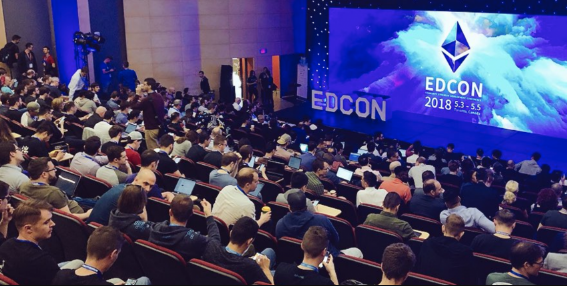
It's safe to say ethereum founder Vitalik Buterin's joke during the first day of EDCON, an ethereum developer conference now taking place in Toronto, had some truth to it, both for himself and the developers who took the stage with him to discuss one of the $76 billion blockchain's toughest challenges: scaling.

In contrast to the day's more cheery asides, the discussion, featuring Vlad Zamfir, Philip Daian, Joseph Poon, Karl Floersch, Hsiao-Wei Wang and Justin Drake, struck a comparatively restrained note, one that was perhaps sobered by the sheer weight of the scaling challenges ahead.

These challenges were on full display six months ago when the platform was brought almost to a halt by the viral popularity of CryptoKitties, a decentralized application for trading digital kittens. More recently, though, even Buterin acknowledged the issue at an event in Seoul, South Korea, saying app developers were "screwed" because of the protocol's current scale.

However, it was a point noted prominently at EDCON as well, with Zamfir, the developer behind ethereum's upcoming consensus algorithm change, giving another prominent voice to the doubts.

Zamfir told attendees:

"I still don't know how scalable it can get. I don't know, I can't even quantify the possible scalability of the blockchain, really."

That said, there's one thing in the platform's favor, and that might be the sheer number of potential solutions to the scalability hurdle, a list that now includes Raiden, Plasma, Liquidity Network, Loom Network, OmiseGO, sharding, state channels and perhaps even others now in the earliest stages of experimentation.

Still, the developers assembled were realistic, noting that there's still a lot of R&D that needs to be done before ethereum can scale to allow for its vision of creating a decentralized world computer.

"What keeps me up at night is that not that many people know how to solve it," said Floersch, a crypto-economics researcher who works on scaling solution Plasma.

So many solutions

Still, that's not to say that understanding of the challenge isn't increasing. For instance, it's now accepted that there are two categories of scaling solutions.

This includes layer-one technologies, like sharding, that necessitate changes to the ethereum blockchain itself, and "layer-two" technologies, which can be built independently and added to the blockchain without an underlying change.

All these solutions are being pursued at the same time, and while that might seem to add complexity and confusion, according to Buterin, it's both the safest and most impactful way to get a solution ready for the network. By actively pursuing all ideas, he said, even if one scaling solution doesn't work, there's always a backup.

And if they all work, the ideas can be combined to make something even better.

"For every single problem, multiple solutions exist," Buterin said, adding:
"If for some reason the trolls are right and sharding gets delayed by five years then guess what, next year we still have awesome state channel networks and we still have raiden and we still have liquidity and whatever else is being built."
Poon, the co-author of the paper on the plasma scaling solution (and also bitcoin's lightning network paper), echoed this point, adding that in striving towards the same goal, developers can make discoveries that might be useful for other scaling approaches as well.

"It doesn't matter what wins, so to speak, because they all do similar things and they all achieve things in somewhat similar ways," Poon said.

Yet, there wasn't unanimous agreement on that topic.

Zamfir, for instance, warned that the multiple layer-two solutions - or those stacked on top of ethereum - could increase the incentive for bad actors to attack the underlying blockchain.

"I don't think the security of these things is independent, in fact, I worry that layer-one solutions will be compromised by layer-two solutions," he said during the panel.

However, Zamfir acknowledged that this experimentation on layer-two technologies is necessary in case there's no conclusion on how to make changes to the blockchain at all.

Touching on another hot topic for the ethereum community, Zamfir said, "I do think that we should experiment with things on layer-two, just in case layer-one governance breaks down and we can't do anything with layer one."

When will it happen?

With all these different efforts, from the outside, you might think ethereum scaling is right around the corner. But there's some disagreement on this, too.

Buterin remains optimistic, saying that within a year he expects plasma, a scaling technologyinspired by the lightning network that looks to decrease the amount of data that's stored on the main blockchain, to be deployed by many different startups in place of proprietary permissioned blockchains.

As detailed by CoinDesk, new advancements, such as Plasma Cash, have further mitigated the risks in how plasma chains communicate with the ethereum blockchain.

And those building sharding technology, another scaling solution that purports to lower the data load by splitting the blockchain into parts running on different servers, are making good progress, according to Drake, a developer working of sharding.

Even though Buterin's recent proof-of-concept for sharding was quickly bypassed by further advancements in research, Drake said a "semi-formal spec" will be released in the next couple months.

Still, though, there were some on the panel who think true breakthroughs lay further ahead.

"In my opinion, in a year nothing substantial will have changed in regard to fundamental blockchain scalability," Daian said. Seeming to hint at Project Chicago, his new initiative aimed at redesigning ethereum, Daian went on, "Hopefully in five years we'll see fundamentally new architectures that are really delivering huge throughputs."

But even when those new architectures arrive, adding them to ethereum will be a challenge since the protocol must make sure it's all compatible. As such, Daian expects smaller ethereum competitors to be the first to patch in the new architectures.

On top of that, many of these solutions have trade-offs - putting decentralization, verifiability and security on the line - that aren't always considered as much as they should be, Poon said.

"Oftentimes people make claims about scalability and they're not really saying what the tradeoffs are," he said.

To avoid this, Floersch emphasized the importance of educating users on the value of decentralized technology, so they don't make regrettable choices in the interim.

And Buterin remained positive, concluding:
"In the longer term, I do think the weaknesses of centralization are going to show themselves."

Source: http://www.vnplaza.info/2018/05/new-ideas-energize-ethereum-though-true.html

Inclusive Insurance? Businesses See Blockchain As Change-Enabler

Inclusive Insurance? Businesses See Blockchain As Change-Enabler


The concept of microinsurance is getting a shot in the arm from new technologies, not least among them blockchain.

A term coined at the turn of the millennium, "microinsurance" is often defined as coverage for people on very low incomes. However, the concept has run up against many of the problems faced by microfinance generally. In theory, it's a great idea, but the practicalities of distribution and operational costs make it unsustainable in many cases.

The most commonly cited use case is coverage to protect small farmers in developing countries from abject weather conditions. From an insurer's perspective, this can involve writing policies or overseeing a claims-handling process for a single-hectare farm (not much bigger than a soccer field) in the African bush. The associated costs far outweigh the meager premium these types of customers can afford.


Or, to put it in layman's terms, the juice isn't worth the squeeze, from the insurer's point of view.

However, a perfect storm of new tech including blockchain, the internet of things and big data analytics is changing the outlook for microinsurance. Indeed, many experts are now saying these technologies, put together, could upend the whole value chain.

While specialist groups like Microinsurance Network have been touting blockchain's potential for a couple years, there is now a steady groundswell of startups such as Etherisc and InsurePal looking at combining microinsurance and blockchain.

The potential is also reaching beyond the world of insurtech, with even large insurance companies like Zurich and Axa experimenting with blockchain for this type of coverage.

To push things forward, Etherisc, an insurtech company that builds products on the ethereum blockchain, recently hired an expert on developing-world microinsurance, Michiel Berende, as its inclusive insurance lead.

Berende, who previously lived in India under a grant program to study how coverage can be cheaply deployed, told CoinDesk:
"Today, it is non-insurers that are managing to make inclusive insurance possible, to make it profitable, and to make it interesting."

Cutting costs


Just last week, Etherisc illustrated how blockchain could help bring efficiencies and lower costs of this type of insurance by introducing weather damage coverage for hurricane-battered Puerto Rico.

In this example, Etherisc's platform locks up premiums in smart contracts on the public ethereum blockchain. When certain pre-set parameters are met (in this case, a weather sensor picking up high-speed winds), payouts are triggered instantly.

Such quick payment would represent an improvement on the status quo - many of the Puerto Ricans who could afford insurance are still waiting for their claims for damage caused by Hurricane Maria to be processed. Known as parametric insurance, this type of coverage does away with the whole rigmarole of assessing a claim - the insurer simply agrees to make a payment if a triggering event occurs.

And in this specific iteration using a blockchain, other costs are mitigated as well - because, unlike large insurers with thousands of employees, smart contracts don't need to be paid or housed in skyscrapers, as Etherisc co-founder and CEO Stephan Karpischek likes to point out.

Similarly, Zurich Insurance Group recently revealed a prototype of microinsurance crop insurance on ethereum.

Designed by Martin Baier, Zurich's program manager for business innovation and development at Zurich, the prototype used an external weather data source API as the oracle to trigger the automatic payout in case of drought or flooding.

The project earned Zurich the distinction of being the only incumbent from its industry to make it to the finals of an insurtech competition held in Zug, Switzerland (nicknamed "crypto valley" for its concentration of blockchain startups).

Another insurance giant, AXA, which recently launched a blockchain-based parametric flight delay product (if the plane is two hours late, the customer gets an automatic payout), is looking at similar applications for rural microinsurance.

Again, the key is having an external data source that would ping the blockchain in the event of payout-triggering events.

"To assess the [crop] yield on a one-hectare farm would be expensive. To significantly reduce costs, you have to use remote-sensing technologies, for example from satellites, to monitor vegetation developments," said Tanguy Touffut, CEO of AXA Global Parametrics.

Inclusive insurance

Apart from streamlining processes and cutting costs, what really gets some people excited about blockchain in microinsurance is its potential to foster peer-to-peer mutuality - simply put, allowing individuals to take on risks that are currently the preserve of large insurance firms.

What if any group of people could create their own pooling system on the spot? These could be instant mini-insurers or mini-mutuals, suggested Michael Mainelli, co-founder of fintech think tank Z/Yen.

"Over time, this could lead to new players entering the market and disintermediation of traditional insurance through the automation of certain insurance products, probably around well-known and common risks," said Mainelli.

Yet Etherisc's Berende sees a broad spectrum of new models. For example, a risk pool to protect small farmers could also involve big players further up the supply chain, like Starbucks or Nestle.

Bringing this type of collaborative commerce to value chains would be a big deal. The world's population is expected to hit nine billion people in the next 10 or 20 years (some 300,000 extra mouths to feed every day).

Around half a billion small-scale farmers produce crops to meet these needs. Yet they are at the mercy of the palpable effects of global warming which are making weather conditions more severe around the planet.

Trying to close a big deal for a pilot scheme in this area, Berende said he is in discussions about blockchains, smart contracts and risk pools with several conglomerates and a large global charity, none of whom he could name.

These risk pools, which could be part public and part privately-owned, might also include farm-input suppliers, farmers' co-operatives, donor organizations and government bodies.

Putting this on a blockchain, so to speak, could help ensure that aid money would only be paid out given specific conditions, as per the smart contracts. A lot of money is spent via initiatives to help farmers cope with climate change, but unfortunately, much of it is lost before reaching its intended location.

Source: http://www.vnplaza.info/2018/05/inclusive-insurance-businesses-see.html

Thứ Ba, 3 tháng 4, 2018

Polkadot's Plan for Governing a Blockchain of Blockchains

Polkadot's Plan for Governing a Blockchain of Blockchains

Who has the authority to change a public blockchain?


It's a question that has been in the minds of top cryptocurrency developers as the many available networks struggle to serve their diverse, often conflicting stakeholders. But that's not to say there aren't norms and best practices - the ability to make and enforce software changes is generally split between the developers that write the code and the computers, or nodes, that install it.

However, Gavin Wood, ethereum co-founder and one of the leaders of an upcoming blockchain interoperability protocol called Polkadot, is shaking up the status quo with a newly published playbook that designates management power directly to token holders.

Distributed in a token sale last year, DOT, the internal token of the Polkadot network, allows its holders to vote directly on a piece of code, which will then automatically upgrade across the network. A way of bypassing the relationship between developers and nodes, the method is not without its controversy, but according to advocates, it's a step up from what is on offer in most blockchains today.

"This initial proposal for Polkadot governance definitely tries to address the shortcomings of many existing chains, which ended up with community deadlock or continuous splits," Peter Czaban, director of the Web3 foundation, which sponsors the research and development of Polkadot, told CoinDesk.

Stepping back, the problem of governance is at the forefront of the ethereum today, as tension concerning fund recovery has raised critiques of the effectiveness of the platform's processes.

"We might have solved consensus for what happens on the chain, but we're still woefully inadequate at solving consensus for what happens to the chain," Gavin Wood said in an interview.

Since the Parity fund freeze in November (which froze some $176 million of the Polkadot token sale), efforts to recover and redistribute funds have largely fallen silent. According to Wood, this is due in part to the absence of a clear process for measuring the consent for, and enacting, controversial changes.
"Recent challenges in ethereum governance have made it clear that regardless of the specific feelings of community members, it is extremely important to have a clear process for making any irregular protocol changes, be they feature additions or bug fixes."

Clarity of process

And it's this need for a formality that, in part, drove the conception of the Polkadot governance method.

In the long-anticipated blockchain of blockchains, every change to the protocol, even minor changes, must undergo a voting referendum in which DOT owners vote on a piece of code.

"It's possible to be able to vote directly on the piece of code that will replace the previous piece of code, and removes any sort of ambiguity in terms of what the change will actually imply," Czaban explained.

These votes work in tandem with a council that can block malicious proposals, as well as leaning the vote if a larger portion of DOT holders are absent. Then, given a majority vote, the Polkadot code base will shift.

In part, the formal method was needed due to the differences between Polkadot and a more conventional blockchain. Instead of nodes, Polkadot consists of "validators," "nominators," "collators" and "fishermen," each securing the network in different ways.

While some of these resemble a typical blockchain node, because of the technical nature of Polkadot - the heart of the code is self-defining - they're not responsible for adopting changes.

"Validators are powerless to block a change that they personally don't agree with nor are they able to hold the network to ransom," Wood said.

According to Czaban, the use of DOT token holders within this framework was largely a practical choice, and he emphasized, one that could evolve into the future.

"There are many different potentially parties that might be involved in the ecosystem, however, the stakeholders are really the only well quantifiable party that we have at our disposal," Czaban said.

Coin-holder controversies

Token distribution, therefore, has emerged as a major lightning rod.

Half of all DOT tokens were sold in October, with the remaining tokens split between the Web3 Foundation and 20 percent allocated for further distributions.

Because control of the network is pegged to this distribution, as well as an elected council that has the power to veto certain changes, ethereum developer Vlad Zamfir told CoinDesk that he has his suspicions about how the idea will work in practice.

"I'm not an expert on their governance model, but I've had enough of a look to definitively disapprove," he said.

At the ethereum community conference, EthCC, last week, Zamfir presented his ongoing research on governance, a key line of inquiry alongside the construction of ethereum's proof-of-stake protocol, Casper.

A vocal critic of what is called "on-chain governance," Zamfir has written that automated methods of decision-making deny node operators an important role, and as such are "antithetical to the ethos of public blockchains."

In an email to CoinDesk, Zamfir explained, "I don't trust coin holders and don't think they should be more explicitly in charge than any other community members."

However, Wood is unswayed, telling CoinDesk that token holders have an economic incentive to act in the best interests of the network.

"Stakeholders have a very clear and broad incentive to do what's right for the network, which essentially means driving the price up," Wood argued. "It's also unreasonable to believe that node operators are somehow experts on protocol changes."

A good start

Regardless of controversies, the Polkadot governance method has been designed so it can be easily adapted, and this is where its creators believe the key value-add will be.

"This is a very pragmatic proposal," Czaban told CoinDesk, "Something that we can do, we can implement, using what we have right now."

While token holders are the easiest participant to quantify, the governance process could extend to include others in the future.

"As there is more research and understanding into the different mechanisms for governance, and who are the different parties that we might be involved, those can be included," Czaban continued.

The Web3 foundation will also be supporting the next meeting of the Ethereum Magicians in Berlin in July, which as detailed by CoinDesk, is a group of ethereum developers seeking to redefine the process of making changes to the platform.

"We are definitely very interested in trying to drill more deeply into the topic of governance," Czaban said.

Vitalik: Ether Limit Is a 'Joke' Worth Taking Seriously

Vitalik: Ether Limit Is a 'Joke' Worth Taking Seriously

That's the gist of a tweetstorm Monday from Vitalik Buterin, in which the ethereum creator said his proposal to create a hard cap on the supply of ether tokens was intended as an April Fool's "meta-joke."


While he said he originally just wanted to see people argue over the merits of fixing the supply, Buterin added that he now believes the idea is "worth considering."

Ethereum Improvement Proposal 960, published April 1, suggested that the ether supply be capped at 120,204,432 units, twice the amount originally sold in 2014. Addressing the cryptocurrency's presently unclear monetary policy, the proposal suggested that a hard cap would "ensure the economic sustainability" of ethereum.

It should not matter whether or not the proposal was written as a joke, Buterin said Monday on Twitter. Because "the words actually were written in the github issue, and the arguments for it are real arguments," he said the suggestions are "very real."

He continued, saying:
"If the community wants fixed supply and people believe that EIP 960 is a good way to achieve that, then it should adopt the proposal. If the community does not, then it should not. This is true regardless of whether or not the original intent was in jest."
Buterin also said some 20 percent of his blog post announcing the EIP was plagiarized from the website of Tron, a digital entertainment blockchain startup.

Yet based on community feedback, Buterin said he "now believes" that developers should look at creating a hard cap. He listed some arguments in favor of the proposal, including that in the long run, "inflationary tokens are a bad idea."

Buterin concluded by saying that the ethereum community has progressed from waiting for the core developers to make every change to debating ideas regardless of who proposes them, but noted that "there's still a long way to go."

Sharding Is Ushering in Radical Ethereum Designs

Sharding Is Ushering in Radical Ethereum Designs

So-called "sharding" may still be theoretical, but the promising implications of the concept are becoming more and more real.

At least that's the case on ethereum, where developers are beginning to see the scaling solution, which would essentially split the blockchain into parts that would run on different servers, as an opportunity to test fundamental assumptions about one of the world's largest cryptocurrencies.

Although initial roadmaps are just now being discussed, ambitious coders are already jumping to introduce protocol-level redesigns that could be made possible by the upgrade.

"Sharding is a huge, huge change to the network," said Phil Daian, a researcher at Cornell University's Initiative for Cryptocurrency and Contracts (IC3). "A lot of people think it provides an opportunity to redesign economic models and other aspects of the system."

For Daian, the realization comes on the heels of a developer retreat in Taipei, where, sharding, and other speculative changes, were discussed. Now, along with an all-star team of co-founders including Ari Juels, Lorenz Breidenbach and Florian Tramer, he putting his efforts into an initiative aimed to redesign ethereum to work more efficiently, Project Chicago.

The project is trying to identify exactly what commodities are being traded at the core of ethereum today. By isolating a variety of network elements, like its gas, storage and UTXO transaction data, the team plans to implement protocol-level markets for what they call "crypto commodities."

"We want to look at all of the services and resources the network is providing and say, 'OK, how do we create a market-based system for price discovery and the incentivization of this,'" Daian told CoinDesk in interview.

The researchers were inspired to create the concept after developing a tool called GasToken, which allows ethereum users to store gas (ethereum's token for paying fees on the network) when it's cheap and sell it at a later date when the price is higher.

And while not many people are using the tool yet, it's effectively shone a light on an incentive flaw within the ethereum system in that, as people look to store GasTokens, it further bogs down the ethereum state - the part of the system that keeps track of all possible computations.

Already, the incentive flaw is reigniting discussions about the need for users to pay so-called "rent" on the amount of time they need their data to be stored on the blockchain. But because GasToken incentivizes people to hoard their tokens, "it's a clear artifact to point to show people why today's model is flawed and why rent needs to be introduced," Daian said.

Still, this isn't the only thing the researchers at Project Chicago think needs to be redesigned.

And as such, Daian spoke more broadly about sharding, stating:
"It could actually provide a once-in-a-lifetime opportunity to radically redesign the system and reset people's expectations from scratch."


Futures market inspiration

That's because, according to Project Chicago, at its core, a blockchain is a marketplace, one where miners sell resources allowed by the software to users. Focusing on this, Daian last week drafted an incentive scheme for peer-to-peer networks, one that would not only pay participants for routing transactions, but apply the same logic elsewhere.

"These resources can be anything from block space, to CPU on full nodes, to permanent storage on full nodes, etc. So, we sort of came at this from the beginning, questioning the pricing models that blockchains have today," Daian said.

Created earlier this year, GasToken was the first step in this direction. In practice, it works by exploiting a feature named "gas refund," which is intended to incentivize users to delete data. But with GasToken, it's possible to abuse the feature, encouraging users to store and drop contracts, as timely deletions can return higher gas.

Daian described this as a "fundamental mis-pricing" in ethereum, in that it values computation as equivalent to storage. "Because of that, we've now created a direct financial incentive for people to bloat the state space and store garbage," he said.

As well as revealing inefficiencies in ethereum's incentive structure, GasToken paved the way for a line of inquiry that could be extended deeper into the protocol layer.

"It sort of made us realize that there's this whole under-researched space of how to deal with these these raw resources that are fundamental to different blockchains today," Project Chicago's Tramer told CoinDesk.

By identifying markets for raw resources, Project Chicago intends to pave the way for other financial mechanisms, such as futures. "[We'll be] looking at different kinds of futures for ethereum, computation, storage and network, and how you can build them," Daian said.

According to Tramer, by speculating on the availability or scarcity of the underlying resources over time, such markets could potentially mitigate price volatility, just like on traditional markets.

Daian echoed this, telling CoinDesk:

"There are really concrete analogs to the real world here. The Chicago Mercantile Exchange (CME) was our inspiration for Project Chicago. And I think a lot of real-world problems could have been avoided by a nicer economic model."

Luxury blockchains?

However, Daian is aware that by ramping up the markets, such schemes may not prove popular.

For example, an increased number of incentives could lead to centralization, attracting large-scale players to participate in storing or mining the blockchain in exchange for rewards. Daian deflected this though, stating, "My argument would be that you're essentially saying you've introduced an incentive and now it will be vulnerable to economies of scale."

He continued to say that bigger economies are both positive for security, in increasing the cost of attacks, and an inevitable economic progression, "even if you do fight them,"referring to monero's recent efforts to defend against large-scale mining.

But there are other potential issues to the mindset, as well. While Project Chicago could provide incentivizes for a host of new participants, such schemes would come at a cost.

For example, rent would mean that token issuers pay a yearly fee to host a smart contract on ethereum, which, failing renewal, could lead the contract to be deleted.

According to Daian, it's possible that new charges could drive users away. "It is worth saying that for all of these crypto commodities, a big is risk in my mind is that people sort of like the cheaper, subsidized model," he said.

Plus, in a competitive market for blockchains, new cryptocurrencies could emerge that offer free usage in the short term, "because there's not that much demand, and perhaps there's good supply."

And while the new incentives could be a big improvement for speed, as well as scaling and decentralization, it's not clear how much those attributes are valued by users.

Vitalik Wants You to Pay to Slow Ethereum's Growth

Vitalik Wants You to Pay to Slow Ethereum's Growth

Could adding a new fee help preserve ethereum in the long term?

It's a contentious statement in light of the debates ongoing across blockchains over how and when users should pay to support what amount to global computing networks. However, the concept is now gaining notable momentum on ethereum, most recently from the creator of the world's second-largest blockchain himself, Vitalik Buterin.

Buterin's concept, described in a recent blog post, revolves around so-called "rent fees," whereby users would be asked to pay to use the network based on how long they'd like their data to remain accessible on the blockchain.

The idea has recently seen interest generally, as ethereum developers have sought to cope with the platform's increased adoption, and, in turn, the increased amount of data being added that all network nodes need to store.

In short, it's a tragedy of the commons issue - if too many people use the resource for free, the network starts taking on the costs itself. And there's plenty of evidence to suggest that there is already reason to worry.

With rising use spurred by popular apps and ICOs, notable developers, including ethereum researchers Vlad Zamfir and Phil Daian, believe the problem needs to be addressed now.

"No one likes talking about rent, but we need to have this conversation," ethereum developer and Thiel fellow Raul Johnson recently tweeted.

"Core developers need to relay this information to the smart contract developer community ASAP to get their opinions on the matter," he continued, adding:
"The current system as it stands is unsustainable."

Fees, explored

Still, Buterin's backing could be a sign that momentum might build around the idea.

So far, he has broached the idea with a pair of proposals on the subject, including a succinct possible solution he calls "a simple and principled way to compute rent fees." And Buterin's first proposal is as simple as its title suggests.

The idea is to compute fees based on a long-term limit on the "state," a slice of special ethereum data that node operators need to store, which tracks who owns the current information about all apps (including user balances, who has posted so much data in, say, a Twitter replacement app and so on).

Under the proposal, state data stored in a node computer's RAM - now about 5GB - will never be allowed to exceed 500 GB. To ensure this, users will have to pay fees based on how long their data is stored. In this way, data is kept in check, since fees will grow if storage creeps toward that limit.

One notable part of Buterin's proposal is that he tries to incorporate a scaling change that ethereum developers have long wanted to add to the platform.

Although the most recent roadmap claims deployment is still years away, "sharding," as it's known, could potentially boost the amount of resources a database can handle by splitting up the data. In ethereum, the idea is, each node wouldn't have to store all of ethereum's historical data - just a slice of it.

"With sharding, the maximum acceptable state size would be per-shard, so the above fees would be decreased by a factor of 100," Buterin said.

Buterin also tries to address another key problem with rent: its bad user-experience. Most rent proposals today would require users to know how long their data will need to live ahead of time, which would be prone to error.

His second proposal explores a way of quashing this annoying guessing game by letting users use their state even after it has expired. Essentially, they would prove that their state existed at a previous point in time, with the help of a cryptographic technique called a "Merkle proof."


Deep-rooted problem

One problem with all this, though, is that fees, kind of like taxes, are never popular.

Bitcoin's years-long debate, for example, mostly centered on fees and the trade-offs associated with them. If fees are increased, less data will be stored, making full nodes easier to run. The downside, of course, is it would make the cryptocurrency more expensive to use.

One question is whether ethereum users and developers will react the same way, arguing "the rent is too damn high." In this way, Johnson worries that suddenly adding extra fees would alarm developers who have already deployed apps on ethereum.

Johnson argues for changes that aren't so knee-jerk and should be phased in slowly to give developers time to adjust.

Not to mention, some believe a similar rent needs to be applied to all cryptocurrencies. Indeed, scaling problems - and the associated fees - are a problem across blockchains.

Daian went as far as to argue that bitcoin needs to apply the same model. Like ethereum, bitcoin currently doesn't charge for the lifetime of a coin.

"Bitcoin is not free of these issues," he said, arguing that its simpler model incentivizes state bloat in a variety of ways, "exposing users to a variety of other consequences of mispriced storage."

Pricing resources to the right degree is such an important area of research, that Daian, a smart contract researcher at IC3, and others at the institute have set up an initiative called Project Chicago dedicated to the effort.

Even if this is a lesser-explored area and researchers haven't yet found a concrete solution, he's optimistic.

Daian concluded:

"No cryptocurrency has figured out good models for pricing these resources thus far, and ethereum's storage rent represents a step in the right direction towards these goals."

Subscribe Now